The conversation around artificial intelligence has been noisy for years: ever-bigger models, ever-better demos, ever-more breathless predictions. Yet the real shift arrives quietly. By 2026, AI doesn’t need to dazzle to matter. It needs to work.
Here’s why the coming year is likely to mark a turning point - not because AI becomes more intelligent overnight, but because it becomes dependable enough to sit inside real systems without constant supervision.
From Clever Tools to Coherent Systems
What changes first isn’t raw capability, but coherence. Newer AI systems are better at holding context, managing constraints and sticking to goals over time. Instead of feeling like a sequence of disconnected prompts, they behave more like a single thinking process. That matters when decisions stretch over hours or days rather than seconds.
For clinicians, administrators and business leaders, this is the difference between a useful assistant and a liability.
Autonomous Agents Enter Grown-Up Organisations
2026 is also when autonomous agents step out of the lab and into regulated environments. The key development isn’t autonomy for its own sake, but guardrails: permissioning, audit trails and clear points of human oversight. Platforms emerging from organisations such as OpenAI and Google DeepMind are increasingly designed for institutions that need accountability as much as performance.
This is why finance, pharma and healthcare administration are early adopters. The work is complex, rules-bound and chronically understaffed - a perfect test bed.
Better Reasoning Beats Higher Scores
Headline benchmark results become less interesting in 2026. What counts instead is steadiness: fewer confident errors, clearer handling of uncertainty and more consistent causal reasoning. In clinical or legal contexts, this is far more valuable than a marginally higher test score.
An AI that can say ‘I don’t know yet’ at the right moment is progress.
Edge AI Comes of Age in Healthcare
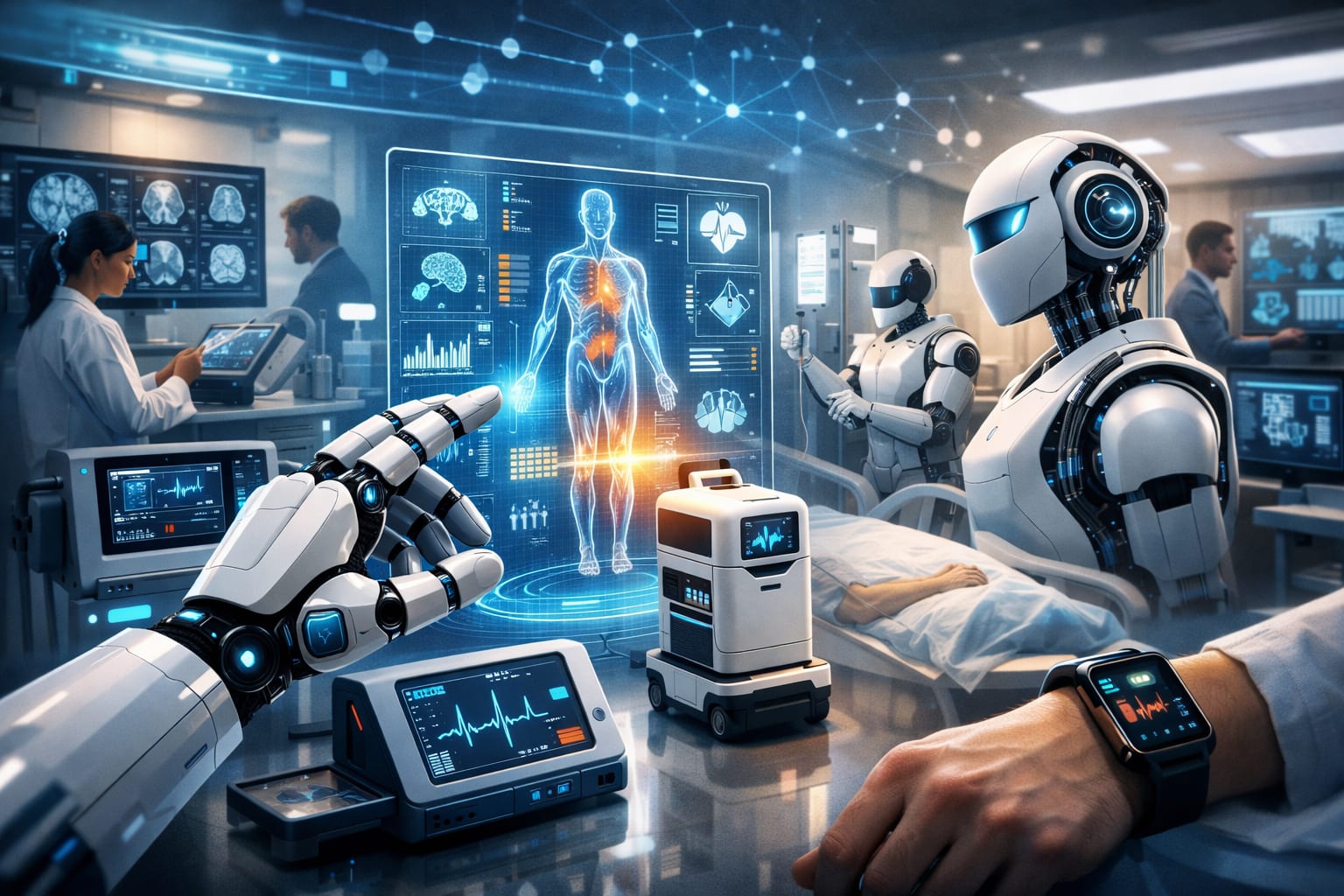
Another quiet revolution happens away from the cloud. Models running directly on devices become powerful enough for serious use. Diagnostic tools embedded in scanners, wearables that analyse data continuously without exporting it, and privacy-preserving on-device inference all become viable as hardware improves.
For healthcare, this reduces latency, protects sensitive data and widens access.
Robotics Grows Up - Without the Hype
The most meaningful progress in robotics isn’t humanoids performing party tricks. It’s general-purpose machines that can follow language instructions, transfer skills between environments and operate reliably in hospitals, warehouses and care settings. By 2026, these deployments stop being pilots and start becoming infrastructure.
Healthcare AI Shifts Role
AI moves from passive support to shared management in bounded domains: imaging triage, pathway coordination, chronic disease monitoring. The aim isn’t to replace clinicians, but to remove cognitive load where it adds little value. In overstretched systems, that distinction matters.
Trust Becomes Technical
Perhaps the most underestimated change is governance. Trust in AI stops being a policy promise and becomes an engineering feature: provenance tracking, cryptographic watermarking of synthetic media and continuous monitoring for bias and drift. These tools enable adoption in national health systems and government departments where hesitation has been strongest.
A Healthier AI Economy
Finally, the market fragments - in a good way. Smaller, specialist models trained on high-quality domain data outperform one-size-fits-all systems for many tasks. Costs fall, experimentation rises and integration becomes easier.
The result? Less spectacle, more usefulness.
Closing Thought
The story of 2026 won’t be a single breakthrough moment. It will be remembered as the year AI stopped trying to impress us - and quietly earned its place as infrastructure.